


"I'm Done": What To Do When Founder Burnout Hits

Updated: May 19

A few weeks ago, a founder booked a coaching call with me for the same afternoon. Her first words when I asked what had prompted her to reach out? “I’m done. I’m exhausted. But I can’t stop.” She’d reached that desperate state so many solopreneurs and founders eventually are forced to recognise as burnout.
What founder burnout really is
Burnout is not just “being a bit tired” or needing a long weekend. It is a state of chronic work‑related stress that has not been successfully managed, leading to emotional exhaustion, cynicism or detachment, and a reduced sense of effectiveness. It often shows up as feeling constantly drained, snapping at people you care about, or struggling to find motivation for work you used to love. Again, burnout is not a bad day or week. It’s a sustained, debilitating and corrosive experience.
For this founder, the clearest sign was that she no longer cared about the business she had spent years pouring her heart into. That emotional numbness isn’t weakness – it’s her nervous system hitting the emergency brakes.
Why founders and solopreneurs are so vulnerable
Founders and solopreneurs are uniquely at risk of burnout for a few reasons.
They carry all the responsibility – sales, delivery, admin, strategy – with no real off switch.
Boundaries between work and life blur completely, especially when your laptop lives on the kitchen table.
Financial and reputational pressure can make rest feel dangerous, so they push through red flags instead of acting on them.
If you’re the face of your business, it can also feel impossible to admit you’re not coping. Many of the entrepreneurs I work with say some version of, “If I stop, everything collapses.” That belief system quietly drives them headfirst into burnout.
The BRNT framework: how we started her recovery
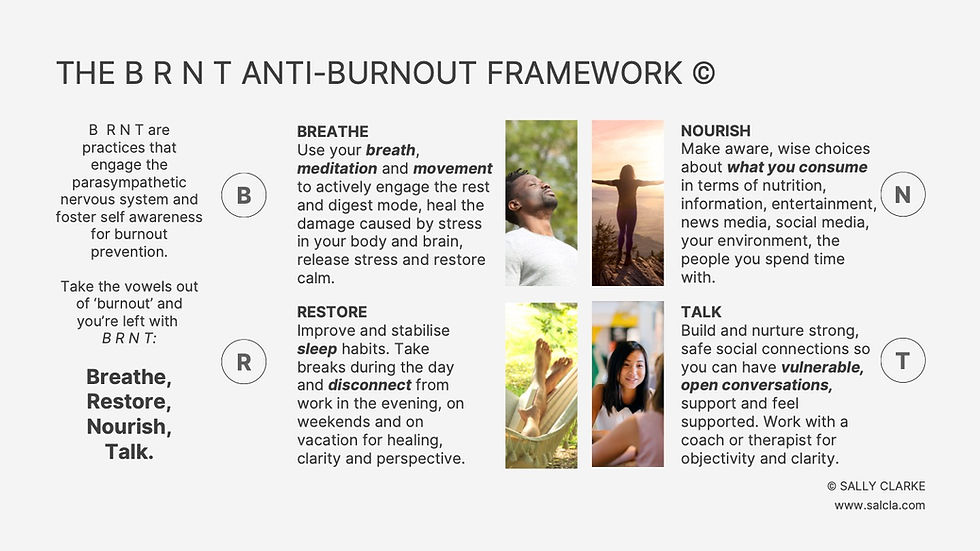
On our call, I introduced her to my BRNT framework – a simple, research‑based tool I developed to help people prevent burnout and heal after it. BRNT drops the vowels from “burnout” and stands for: Breathe, Rest, Nourish, Talk.
For the week ahead, we made a concrete, doable plan:
Breathe – Two five‑minute “nervous system breaks” a day: slow breathing, grounding, or a gentle walk without her phone to re‑engage her parasympathetic “rest and digest” system.
Rest – One evening fully off: no email, no “just quickly” fixing the website, just sleep, light TV, or reading for pleasure.
Nourish – Eating actual meals away from her screen, adding one small thing each day that feels genuinely restorative (sunlight, stretching, a favourite podcast) instead of doom‑scrolling.
Talk – Telling two trusted people what was really going on and scheduling our follow‑up session one week later for accountability and support.
We also named one practical boundary she could set immediately – in her case, pausing new client intake for two weeks – to stop the overload from getting worse.
I’ll be checking in with her in a week’s time. Not to hand out gold stars or give her a guilt trip, but to review what worked, what didn’t, and adjust the plan so it’s sustainable rather than another perfectionist project.
That’s the heart of my burnout coaching: translating insight into small, consistent actions that genuinely change how you live and work.
Four things you can do this week
If you’re recognising yourself in her story, here are four steps you can take over the next seven days.
Name it
Stop calling it “a busy phase” if it’s more than that. Write down the signs you’re noticing – exhaustion, irritability, numbness, brain fog – and acknowledge that burnout, or at the very least chronic stress or overwhelm, might be on the table.
Pick one boundary
Choose a single boundary that would give you a little more breathing room: a firm stop time of 5pm every day this week, no meetings before 10am, or saying no to one non‑essential request.
Use BRNT in micro‑doses
Ask: What is one small thing I can do today to Breathe, one way I can Rest, one thing that will Nourish me, and one person I can Talk to honestly? Keep it tiny, daily and doable.
Get support
Burnout is deeply personal, but it’s not something you have to navigate alone. Whether it’s a therapist, a trusted peer, or structured coaching, create a space where you can be honest, make a plan, and be held accountable.
This is exactly the work I do with clients – including founders and solopreneurs – through coaching for burnout prevention and recovery, as well as workshops and programs for teams and organisations. If you’re at the point where something has to change, consider this your invitation to take that first step and reach out.


Comments