


8 Practices for Burnout Prevention (for busy professionals)


The B R N T Framework is based on extensive research I did for my first book. It distills practices that help engage the parasympathetic nervous system and foster wellbeing, health, and performance. Just drop the vowels from ‘burnout’ and you have it: Breathe, Rest, Nourish and Talk. Four practices that help prevent burnout – and can help us recover after burnout, too.
What does it mean to Breathe for Burnout Prevention?
Breathe means using practices that connects you with your breath and your physical body, and that engage the parasympathetic or ‘rest and digest’ mode of your nervous system. (Highly stressed or deep in burnout? Make sure to opt for restorative practices rather than ones that exhaust you further.)
Here are some examples of what Breathe can look like for busy professionals.
Pre-Comms Pause
Before opening a new email or message, or answering a phone call: take one deep breath, focusing on long, full inhalation and smooth, complete exhalation.
If the email, message or call is potentially high-stress, take 2 breaths.
This creates a mini-pause to enable a conscious rather than reactive response. It also means, when you’re going through a few emails, you get a decent breathwork practice in as you go.
Doorway Breath Technique
Every time you walk through a doorway (at home, in the office, at the store), take 1-3 deep, intentional breaths. This anchors breathwork to a common physical cue.
Draw the breath deep down into your lungs, see if you can fill them to the brink, then exhale smoothly all the way out, aiming for emptiness and ease at the end of the breath.
Build a Meditation Practice
Is your brain ‘too busy’ for meditation? Let me gently push back: (1) so is mine yet meditation still works, and (2) people like us need it the most.
Meditation is not about emptying the mind or ceasing thinking. It’s about engaging our ability to observe and detach from the our thoughts. When we do – even for nanoseconds – this has a profound effect on our wellbeing.
Start with a course; use guided meditations for support. Even 5 minutes a day, done consistently, has an impact.
In-Transit Body Scan
During your commute, take 2-3 minutes to do a body scan. Set a timer, or hit play on a fav song. Notice and release tension from your brow and jaw, relax shoulders and belly. Observe any tension in your arms, hands, legs and feet and let it go. Maybe drop your head from side to side to stretch the neck, or wiggle your jaw, fingers and toes.
Anchor this practice to a station or on-ramp you pass every day to make it a consistent and habitual.
Prioritize Your Fav Exercise
Many people start exercise for physical health, then quickly realise the benefits to their mental health, too. Running, walking, working out, swimming, surfing, dance: whatever your jam, build it into your schedule as a non-negotiable.
Bonus if it also has a social aspect (then you’re also doing the T of BRNT!).
Note: if you are highly stressed or deep in burnout, an intense workout regime can cause further harm. If in doubt, opt for restorative practices like yin yoga or a slow walk in nature.
Get Sensory With It
Sensory practices help you anchor yourself in the present. There are many way to access calm through the power of our senses.
Try scent – have a vial of your fav essential oil at your desk so you can use it when doing a breathing exercise.
Or, pop earbuds in and listen to your go-to uplifting music.
Use touch: pat a pet, feel your own forearms and wrists, press down through the soles of your feet into the earth.
Or, look out the window at the movement of birds or leaves.
Alien Breathing Practice
Sound weird? Good.
Play with breathwork by imagining you are an alien, and you can breathe in through different parts of your body. Draw breath in and out through the soles of your feet, your fingertips, the crown of your head, your lower back, your knees, your eyes, wherever.
Use between meetings, during your commute or when waiting in a queue.
This is a fun one to use with kids or even to start a team meeting.
Access All Nature
Nature is healing, in part because humans are part of it (we are just really good at forgetting).
Ground yourself in nature whenever the opportunity presents: in the park during lunch, on the train as you pass a river or treetops, during a hike, a beach walk or a swim.
Our towns and cities offer many moments for us to connect with nature: even if it’s a flower stand in the mall or shrubs down the median strip. Notice, use the cue to take a deep breath, and remember your own inherent place in nature.
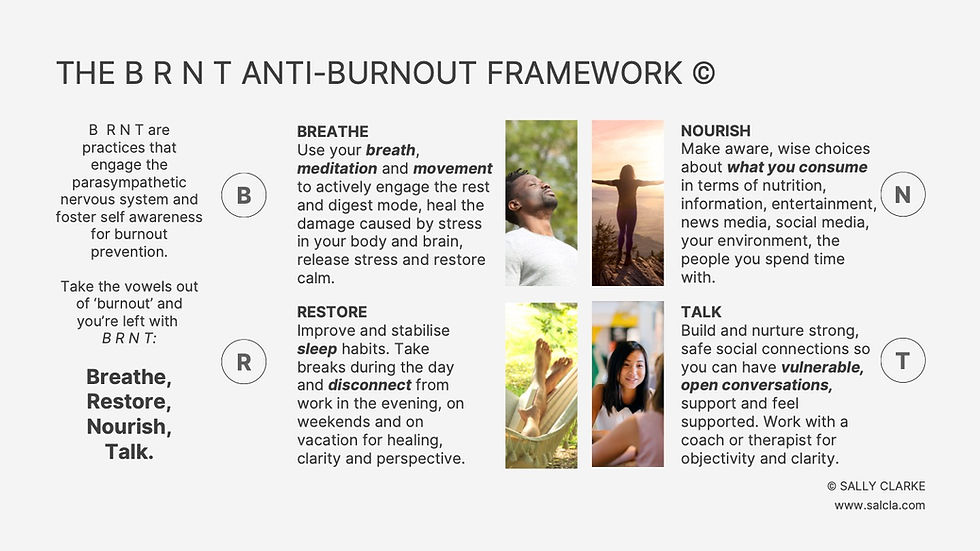
The B R N T Framework© is a powerful way of ensuring self-awareness, wellbeing and sustained high performance.
Want to improve wellbeing, performance and productivity in your team or organisation? Reach out now to learn about my impactful workshops, trainings and sessions: including on B R N T for leaders, teams and individuals.
Comments